
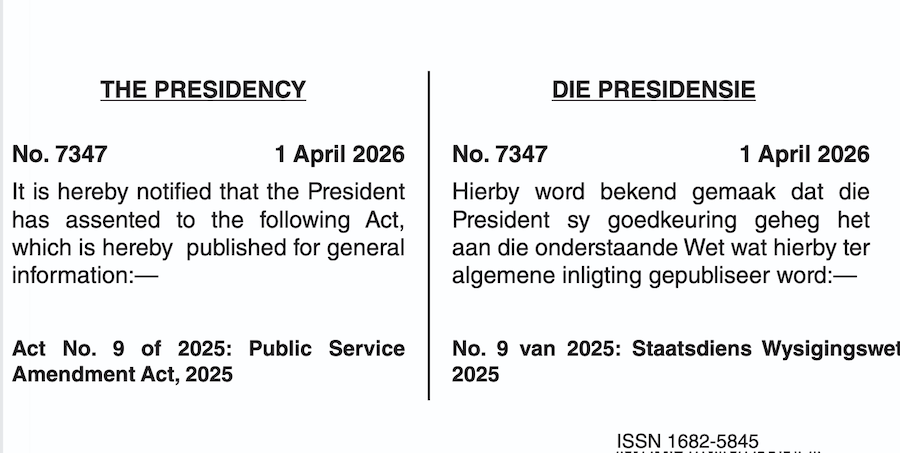
Statement on the President signing the Public Service Amendment Act into law
Issued by the Public Affairs Research Institute (PARI)
9 April 2026
The Public Affairs Research Institute (PARI) welcomes the signing into law of the Public Service Amendment Act. This is a significant reform. We caution, however, that the legal framework to support the development of an impartial public administration and a productive political-administrative interface is still not fully in place.
Tensions between political leaders and administrative heads in the public service have been exacerbated by a lack of alignment between the wide administrative powers given to executive authorities (politicians) under the Public Service Act, and the responsibilities given to departmental heads (HoD) as Accounting Officers under the Public Finance Management Act (PFMA). Ideally, the political executive should play its appropriate role in defining policy, exercising oversight over implementation, and disciplining senior administrators for non-compliance. Officials should implement the policy of government (within the framework and values of the Constitution and other applicable laws), and senior officials should have the appropriate authority to manage departments in pursuit of this outcome.
We therefore welcome the Public Service Amendment Act: politicians will no longer have the authority to appoint staff below the level of HoD in the public service. The Act moves this authority and responsibility for appointments, and for HR management and administration more widely, to the administrative head of the department (i.e. Directors-General and HoDs in national and provincial departments respectively). The Act also bars HoDs and employees directly reporting to them from holding political office (political office includes the position of party chairperson, secretary, and so on). We hope these amendments will better distinguish political roles from public administrative roles.
While these changes are welcomed, the reform journey to develop an impartial public administration (as envisioned in the Constitution) is incomplete. There is still plenty of room for political corruption to enter into decisions about who is appointed as the Director-General or HoD, and for that DG or HoD to then promote those interests down through the administrative hierarchy (and into public procurement decisions) via their (new) authority over recruitment and appointments in the department.
As PARI has argued before, and government’s own Professionalisation Framework underscores, the task is to introduce appropriate checks and balances in appointments and dismissal processes in the civil service so that the administration is better insulated from political corruption. This will assist in making our public administration and more responsive to policy, and to democratic mandate more widely.
We welcome government moving forward with concrete legal reforms, and we hope to see further movement toward a public administration that serves the people of South Africa.
Contact: Dr Sarah Meny-Gibert, PARI, sarahmg@pari.org.za
