
Zain Mayet
In May 2026, government published the Reviewed Draft White Paper on Local Government – the first complete overhaul since 1998, when the original White Paper shaped the operational design, political culture and institutions of post-apartheid municipalities. This matters because South Africa’s entire local government system is currently in disarray and municipalities have weathered nearly three decades of financial strain and institutional pressure that the 1998 framework never anticipated.
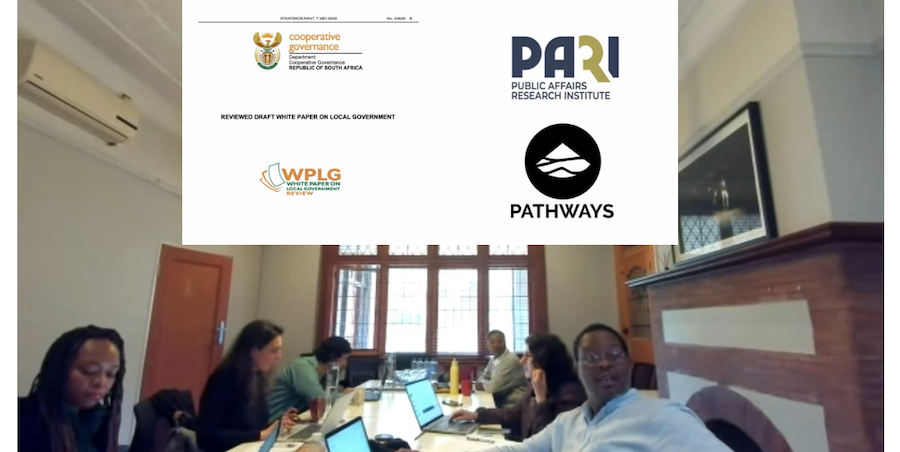
The Draft makes several, mostly welcome, recommendations. But the public consultation process gave stakeholders too little time to weigh up a document this significant. To address it, the Public Affairs Research Institute (PARI) and the Zabalaza Pathways Institute convened a two-day forum, bringing together academics, civil society practitioners, governance specialists and community-based researchers to interrogate its most critical proposals.
In a previous engagement with this process, PARI made a submission on the Discussion Document on Local Government Reform, published in January 2025 by the Department of Cooperative Governance and Traditional Affairs (COGTA). PARI argued that the 1998 White Paper’s developmental, democratic, redistributive and cooperative vision still holds for South African municipalities today.
In the present discussion, two chapters took focus: traditional leadership, perhaps the most contentious in the document and the least understood; and climate resilience, which proposals participants found dangerously vague and disconnected from municipalities’ legal and practical obligations.
The issues present real-world consequences, particularly for rural municipalities situated on former bantustan land, where having the weakest economies, the least development and the deepest poverty mean they are least resilient to climate change. Municipalities and traditional authorities need to plan for a volatile climate future together, but the White Paper offers no roadmap for collaboration. Eastern Cape organisations were blunt about the cost: without a clear structure, decisions get made slowly, badly or not at all.
Many rural residents continue to access land through traditional authorities. But as PARI’s Land and the Just Transition Guide notes, at present, customary land allocation is not always consistent with municipalities’ spatial plans, and interactions between the two institutions largely happen on a case-by-case basis. The White Paper correctly identifies this as an issue. But the solutions it proposes (discussed below) are mostly technical fixes and do not articulate a broader set of principles for how the two kinds of institutions should relate to each other.
Participants also gave due credit: the Draft correctly diagnoses systemic failures such as an unworkable two-tier district model, political interference and mounting financial pressure, and its proposed solutions are reasonable, if still in need of sharper research and real political consensus.
On traditional and Khoi-San leadership, the White Paper could create binding local compacts tied to Integrated Development Plans and budgets which could clarify funding and roles of traditional councils. But the authors lose their nerve in addressing the politics and history of traditional authority whose councils have been complicit in expropriating land for mining and development, with a dismal record on women’s land rights. Section 24 of the Traditional Leadership and Khoi-San Leadership Act already lets councils sign agreements without community consent and participants worried the compacts would allow municipalities and traditional leaders to conspire against community interests.
The workshop’s clearest finding: a mechanism to represent communities was absent – citizens get no formal seat when municipalities strike agreements affecting them, promoting exclusion rather than cooperative governance. Further, many councils are not formally established as the law requires, raising real questions about their standing as constitutionally recognised partners.
To be taken seriously, the White Paper needs community representatives at the table alongside traditional authorities and municipalities; it must involve those who allocate land in creating a shared understanding of the municipality’s customary practice; and provide clarity on how new legislation arising from the White Paper relates to existing law.
This criticism lands hardest in rural South Africa, where climate change lands hardest too. The Draft gives no sense of how municipalities and traditional authorities might work together to mitigate climate impacts or use land for renewable energy and adaptation. Thus, the workshop focused on this chapter and stressed that: without guidelines for collaboration, there’s no closing the gap between fragmented national authority and locally felt climate impacts.
While the chapter rests on the Climate Change Act’s legal foundation, participants found it vague, routine and inadequate to respond to the crisis. It barely engages the Act’s binding requirements and ignores the Just Transition Framework and Presidential Climate Commission entirely, as though resilience could exist apart from a just transition. The Draft misses how insecure land tenure deepens climate vulnerability – where local governments already struggle to protect land rights – with knock-on implications for participation, consent and infrastructure planning.
Participants found specific proposals for early warning systems, integrating climate risk in planning and financial incentives for climate resilience to be generic and underfunded relative to the substantial threats. Disregard for indigenous knowledge and civil society expertise further eroded the chapter’s credibility. The fix, however, is straightforward: real and adequate resources are needed for municipalities to meet their just-transition obligations, as was demonstrated by examples of implementation difficulties at Komati.
Other structural concerns surfaced at the workshop: the White Paper uses outdated census data to calculate provincial shares, which has already resulted in the Eastern Cape being denied allocations due to a lack of funds. Moreover, rather than strengthening existing governance structures, the Draft proposes a new transition management agency – another bureaucratic layer on an already fractured system.
To contribute to a just transition, the Draft White Paper’s vague procedural language must be replaced with substantive structural analysis that reckons with the legacy of apartheid planning and the bantustan system: it must include communities as genuine co-governors, not consulted participants; and strengthen existing institutions, provinces, COGTA and the Auditor-General with resources and accountability, rather than building new ones from scratch.
The White Paper has named the disease. Whether it can also write the prescription and whether government follows it, will decide the public’s confidence in local government.
