
Images: Authors
By Daniel Sher, Zain Mayet and Murial Kwena
With the 2026 local government elections still warm, a great deal of public and media attention has been devoted to the country’s underperforming metros. This urban bias comes at the expense of obscuring the challenges facing smaller municipalities. These are most pronounced in rural, former homeland areas where increasing numbers of people are settling on customary land which is located within the boundaries of ‘wall-to-wall’ municipalities but outside of the regulatory and fiscal frameworks of local government.
Commentators have highlighted that this can lead to disaster risks when, for example, houses are built on floodplains or steep slopes. Equally important, but perhaps less recognised, is the way this limits local government ability to balance competing land uses.
Bushbuckridge Local Municipality, in Mpumalanga, offers a snapshot of some of these issues and the way in which rapid population growth is fuelling ongoing competition and conflict around scarce land.
During Apartheid, Bushbuckridge was split along ethnic lines across two homelands, Gazankulu and Lebowa. Forced removals channelled tens of thousands of people to the area: between 1972-1992 the population grew from 127 000 people to 356 000. This led to serious pressure on land as plots shrank and newcomers received progressively smaller pieces of land. While some subsistence farming continued, most people were forced to depend on labour migration to survive.
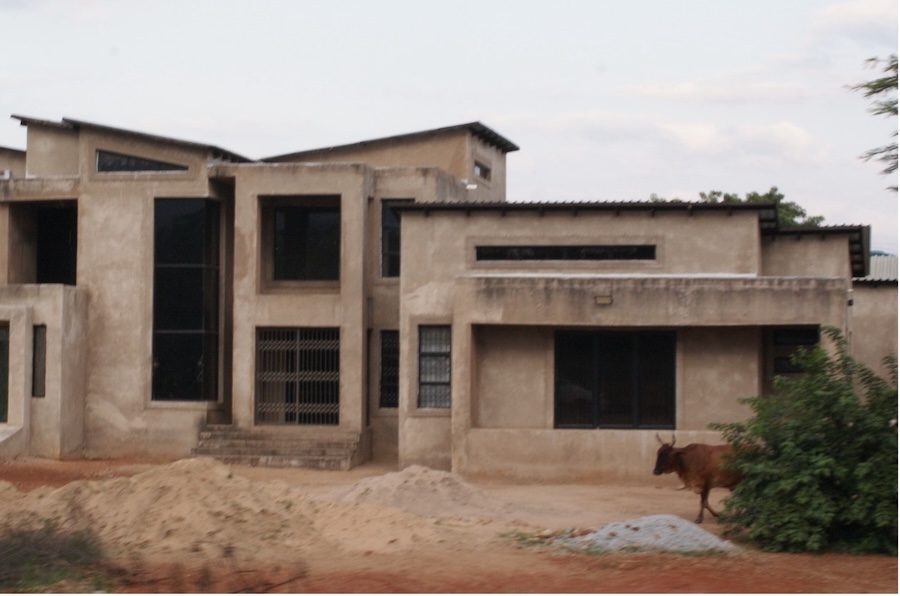
With the end of Apartheid, some people did leave the area, probably to search out better opportunities elsewhere. But remarkably, the population has begun to grow again – in fact, between 2011 and 2022 it was one of the fastest growing areas in the country, increasing by close to 40%. Many of the new houses are noticeably bigger and built in a suburban style on small plots. These are in stark contrast to larger areas of land where others supplement their government grants and remittances with subsistence farming. The more recent arrivals are negotiating land for settlement from traditional leaders, family holdings, and increasingly also through informal sales.
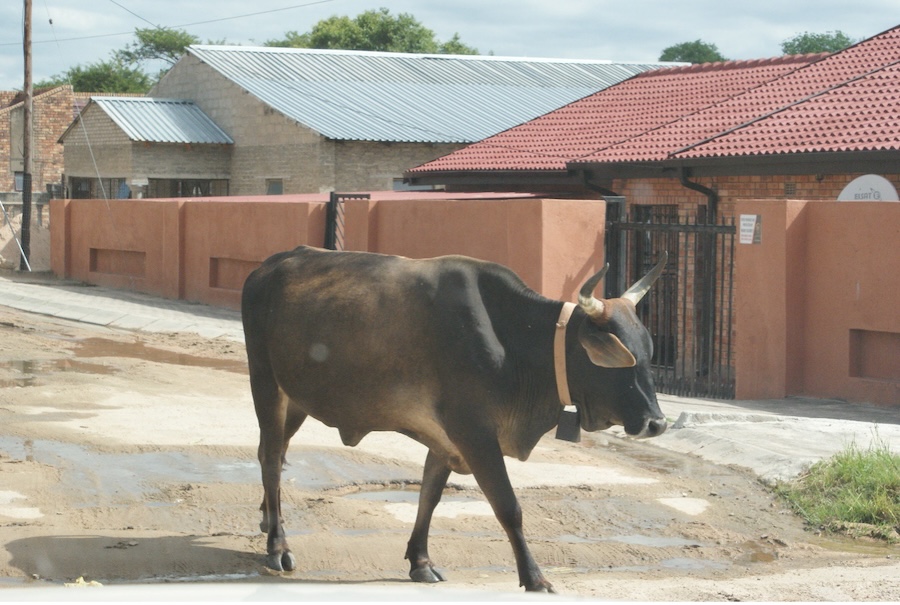
The increasing demand for land is putting huge pressure on the remaining agricultural activity in the area. Livestock farmers are directly affected by these changes. Land which was historically used for grazing camps has been subdivided for housing. This has resulted in conflict between cattle herding and increased residential settlements. With limited grazing space remaining, livestock roam both highways and neighbourhoods where they pose a safety risk to themselves and vehicles. Some cattle farmers are organised around the different dipping tanks in the area, and through their committees are able to resist the complete loss of their pasture for the time being.
Crop farming is also declining as low-lying areas and fields traditionally used for agricultural production are now being sold off as residential stands. Data from one area of Bushbuckridge showed that households’ use of fields (for cultivating crops) has declined by around a third from 2010-2023. This not only undermines subsistence food production but also leads to increasing ecological vulnerability.
The increased population density has been accompanied
by establishment of a number of retail malls and shopping centres. The retail centres occupy land with a footprint ranging from 3 – 14 hectares. While shopping centres generate much needed employment and offer convenient access to goods and services, they also occupy a growing land footprint in well-located areas.
These processes are creating new winners and losers. While Bushbuckridge is far from a self-sustaining agrarian economy, for a significant minority of households farming remains a valuable means of providing food outside of the cash economy, even if it only supplements other sources of food. This is important given that in 2025 there were over 15 million people in South Africa who did not have enough to eat. But as competition for land grows, the value of customary land as a safety net for poorer people is coming under threat. This is a real danger in an area with over 50% unemployment.
Ideally, the municipality should be working to mediate these pressures. By law, every portion of land within South Africa falls within a municipality, and municipalities are responsible for spatial planning within their areas. Municipal planning instruments and regulations, such as the Spatial Development Framework and Land Use Scheme, lay out a vision for the form which future development will take. In terms of the Spatial Planning and Land Use Management Act (SPLUMA), these policies and regulations must be guided by five principles, namely spatial justice, spatial sustainability, efficiency, spatial resilience and good administration.
This engages national government priorities too: the Department of Agriculture’s Subsistence Farming Directorate also works to support subsistence producers and food security in line with the National Policy on Food and Nutrition Security.
The Bushbuckridge Municipality recognises the challenge and is taking steps to engage with traditional authorities around settlement planning, and areas of flood risk. But so far it has been unable to constrain the loss of agricultural land to housing.
At a workshop convened by scholars from the Gauteng City-Region Observatory (GCRO) and Wits University, researchers presented similar cases of ‘extended urbanisation’ taking place in other former homeland areas around South Africa. There was near universal agreement that this phenomenon throws up governance, planning and fiscal pressures which are not yet adequately recognised in policy. It is important that a flexible land use management system should be developed for the former homeland areas, as mandated by SPLUMA. But there is currently no guidance or framework for what that should look like. Until that changes, municipalities like Bushbuckridge will be left to negotiate with different traditional authorities on a case-by-case basis. And the remaining herders and farmers of Bushbuckridge will continue to face pressure from home builders.
