
By Zain Mayet
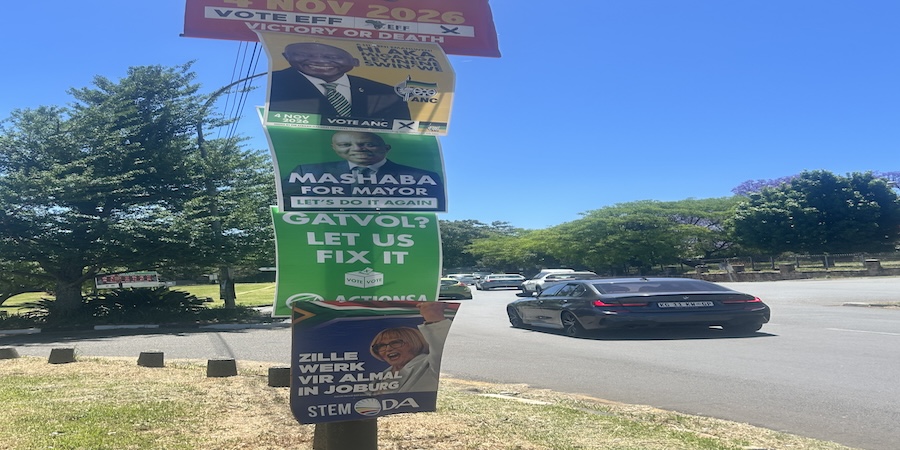
South Africa’s local government elections on 4 November will determine who represents each ward, but in many municipalities, elections will not settle who governs. Where no party wins an outright majority, that question moves from the ballot box to the negotiating table. Between 2021 and February 2026, 80 of 213 councils were hung at some point. In some councils, smaller parties will hold decisive cards, although politicial scientist Susan Booysen expects mid-sized parties to call the shots while micro-parties tend to back larger ones. In others, larger parties will have to deal with each other, and their voters may not like the partner chosen. However parties play their hands, the result will shape municipal government for years. There is a strong democratic case for the terms of that game to be known before votes are cast, not after. The missing card is programmatic clarity, that is: what each party wants, and what it would trade to get it.
The time the law allows for building a government is strikingly short. Under section 29 of the Municipal Structures Act, a newly elected council must hold its first meeting within 14 days of the results being declared. The municipal manager presides over this meeting until councillors elect a speaker, who then chairs while the council elects the mayor and other office-bearers. Ideally, those votes rest on negotiated terms for how to govern, but nothing obliges parties to publically share those terms. A council without an agreement can convene and then adjourn, though not for long.
Two weeks is very little time in which to deal an opening hand. After the 2021 elections, 70 councils nationally and 18 municipalities in KwaZulu-Natal alone were hung, each needing an agreement within the same window. By comparison, Germany’s Bundestag elected a new chancellor, roughly ten weeks after the February 2025 election. New Zealand’s three-party coalition was finalised about six weeks after polling day in 2023. The Netherlands took a record 299 days to form a government in 2021/22. A 14-day window leaves far less room for bargaining over a governing programme.
This raises three concerns for democratic accountability.
First, deals tend to be about positions rather than programmes. Booysen describes coalition-making as a pursuit of the ‘magical number’, with governance a secondary thought, and De Vos has noted that media coverage focuses on who gets which post rather than what the government will do. A longer window would give parties more time to negotiate around more programmatic concerns, though it would not oblige them to do so.
Second, a council can elect a mayor without a governing coalition being formed. The Act requires a ‘majority of votes’, a phrase that has itself been contested, and parties can therefore place a candidate in office without agreeing to govern together. In Johannesburg and Ekurhuleni in November 2021, the Democratic Alliance’s (DA) mayoral candidates were elected with the votes of ActionSA and the Economic Freedom Fighters (EFF), although the DA stated that no deal had been made with either party and the EFF insisted that voting for a candidate did not amount to a coalition. Such a government may lack any shared programme. The cards are played before anyone at the table has agreed on the game.
Third, office-bearers are elected by secret ballot, so residents often cannot see how their councillors voted or what was offered in exchange for support. As Jaap de Visser of the Dullah Omar Institute has argued, councillors exercise a public mandate, and secret voting is fertile ground for ‘sinister backroom dealings’. In effect, the decisive cards are played face down.
Parliament has recognised the problem. The Municipal Structures Amendment Bill would extend the first meeting from 14 to 30 days and require written coalition agreements to be published in the Provincial Gazette, although it does not say what they must contain. But the committee has been advised that the Bill will not be finalised before the election, so the 14-day rule stands. If there is too little time after the vote to negotiate a credible programme, its outline needs to be on the table before the vote.
That changes the question voters and journalists should put to parties. ‘Who would you govern with?’ is really shorthand for ‘what will you compromise on?’. That need to be asked and answered directly. Party names invite slogans and grudges, while issues invite negotiation. Some parties already say who they will not work with, as the Freedom Front Plus (FF Plus) has in the case of the EFF, uMkhonto weSizwe Party (MK) and Pan Africanist Congress of Azania (PAC). That tells voters who is out, but it does not tell voters enough about what the party would trade. Consider two illustrative positions (i.e. these are not any party’s actual platform): one party makes dissolving Johannesburg’s municipal entities its price for support, another insists that resident associations control ward budgets. They could govern together without liking each other, because their priorities do not collide. A party that states its red lines openly is easier to bargain with and easier to hold to account. A party that will not say what it stands for is a joker, as it can become whatever the table needs once the hand is dealt, offering it’s voters little in regard to coalition clarity.
This is a demand for programmatic clarity, and voters can make it specifically. First, what matters most to you? Second, what will you give up to get it? As former Independent Electoral Commision (IEC) deputy chair Terry Tselane puts it, ‘You can’t have a coalition without a programme.’ It is also a test: if what a party calls its priority is the first thing it trades away, it was never a priority.
Five commitments, drawing on proposals by De Vos and De Visser, would let parties show their hand before the vote. First, name the two or three issues you would refuse to govern without. Second, say what you would concede, and where your red lines lie. Third, state the terms of your support: a full coalition, or confidence and supply, where a party backs the government on confidence and budget votes in return for agreed policy commitments without sharing the executive. Say whether support depends on programmatic commitments, such as clean audits or water infrastructure repairs, or on seats on the mayoral and oversight committees; parties need not name individuals, only whether positions are a condition. Fourth, publish any coalition agreement in full within a week of signing it, whether the Bill has been enacted, explain why each party took the portfolios it did, and support open voting for mayors, speakers and whips. Finally, agree in advance how disputes will be resolved. In New Zealand, partners use an ‘agree to disagree’ provision that lets them differ publicly on specified issues without bringing down the government, a better way to settle disputes than motions of no confidence
None of this requires legislation, only the willingness to play with cards face up. In most councils this November, any vote may be a vote for a possible coalition. Voters should know which one before 4 November, not discover it a fortnight later.
