
Image: ID 14745861 © Jborzicchi | Dreamstime.com
Madlanga Commission exposes failures in holding urban power to account
[First published in Business Day]
In this silly post-election period, characterised by drunken hyperbole, utter despair and hopeful platitudes, we must try nonetheless to look at the country with a sober lens. There is nothing better for that purpose than South Africa’s favourite pastime: observing a commission of inquiry.
The Madlanga commission grounds us in reality. It sharpens our view of what happens when there isn’t a progressive social force that can consistently extract concessions from city elites for the benefit of residents.
In cities struggling with economic development and deep inequality, without a strong mass movement with real connections to powerful elites to act as a check on their power, residents across the board are worse off.
Corrupt law enforcement elements connected to organised crime networks are the social force occupying a space in city politics no longer occupied by progressive social movements. The outcomes are benefits to politically connected elites and tokenistic gestures for the residents of the city.
A senior member of the police organised crime unit, Fannie Nkosi , is alleged to have performed as a “runner”, passing information between political party elites, senior officials in the Tshwane metro and criminal figures. Nkosi allegedly received and passed on confidential financial information on contracts and the employment of staff in Tshwane, seemingly having a hand in a wide range of matters in the city.
The commission also discussed how Nkosi had been in contact with criminal figures, including Vusimusi “Cat” Matlala . It is worth noting that while social movements are weak, fragmented and struggle to make meaningful demands on city administrators and politicians, police officials such as Nkosi are empowered to move across regional and institutional boundaries to pressure elites in city governments across Gauteng to benefit a narrow crime network.
Another powerful social force that has expanded its reach, moved across sectors and ventured into new terrain is the taxi industry. It is a serious player in the politics of any large city in South Africa, a fact it would be foolish to ignore.
In a comparative study by sociologist Benjamin Bradlow on São Paulo in Brazil and Johannesburg in public goods provision, he shows how transformative outcomes for residents in challenging circumstances is achievable when there is an embedded relationship between social movements and city bureaucrats and political elites.
The positive case for the latter lies in São Paulo. Sadly for us, as Bradlow shows, Johannesburg elites do not see themselves as accountable to a “broader social sphere”. Grassroots organisations in the city are usually small, fragmented and, where active, mobilised towards hyper- localised issues affecting a confined area within the city, and are thus unable to exert sufficient pressure on the levers of power.
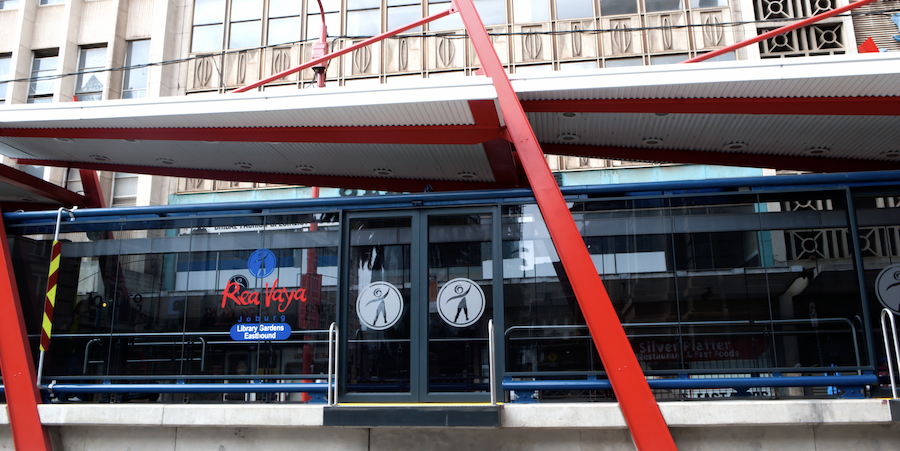
Starting in 2009, Johannesburg initiated a bus rapid transit system, Rea Vaya , part of a public transport modernisation project. If successful it could have transformed how working class people who live on the periphery experience the sprawling city.
Bradlow argues the city led with a technology-first approach, meaning it prioritised implementing the new technology, essentially referring to the innovations accompanying Rea Vaya, such as digitised ticketing, dedicated lanes and modern stations.
The approach taken did not engage with the institutional realities, illustrated by an attempt to in effect bypass or ignore the taxi industry. Without buy-in from communities and meaningful engagements with the taxi industry, Rea Vaya has to date been unable to become an established, successful player in the sector, and unable to offer any competition to the taxi industry. The result is that the Rea Vaya system is not efficient, reliable or cheap — that is failing in its objectives — while the taxi industry remains the dominant factor in public transport.
Bradlow asserts: “Johannesburg’s transportation reforms were driven by a technocratic image of international ‘best practice’ that was disconnected from a meaningful political dialogue with either operators or users.”
While Bradlow’s charge can arguably be levelled at the city in this and many other initiatives it has conceived, his analysis may have failed to adequately account for the taxi industry’s deep and wide reach in city politics. In other words, it may not have been that the taxi industry was not properly engaged, but that Bradlow may have underestimated the industry’s political influence and capacity for violence.
Its reach was on full display during testimony at the Madlanga commission, where a video was shown of taxi boss Joe Sibanyoni making a thinly veiled threat against President Cyril Ramaphosa and mineral & petroleum resources minister Gwede Mantashe in relation to his demand for a 30% stake in bus company Putco, stating if there is anyone interfering with Putco it must be known “it’s us”.
A study by historian Tim Gibbs examining Durban/Ethekwini politics demonstrates a situation where an alignment between city bureaucrats and policymakers, with a developmental agenda and strong mass grassroots movements, facilitated substantial progress in housing provision for poor residents. When this coalition fragmented the vacuum was filled by powerful, nefarious social forces on whom residents are unable to extract democratic accountability. This fragmentation contributed to the explosion of political violence in Durban we have witnessed recently.
The Madlanga commission is the outcome of revelations by KwaZulu-Natal police commissioner Lt-Gen Nhlanhla Mkhwanazi relating to specific events and networks. The commission’s mandate is thus relatively narrow in scope. Yet it has illuminated a new dimension of politics in the metropolitan municipalities in South Africa that we only caught a glimpse of a decade ago in the insider’s account of Nelson Mandela Bay by Crispian Olver in his book How to Steal a City.
The commission has been a window into, and a timely reminder of, the reality of local politics in the country’s biggest cities. While voting is important, it is also crucial that residents organise and mobilise to wrest control back from the political and criminal elites who have laid waste to our cities, and place public pressure on them for the provision of public goods and much needed economic development.
