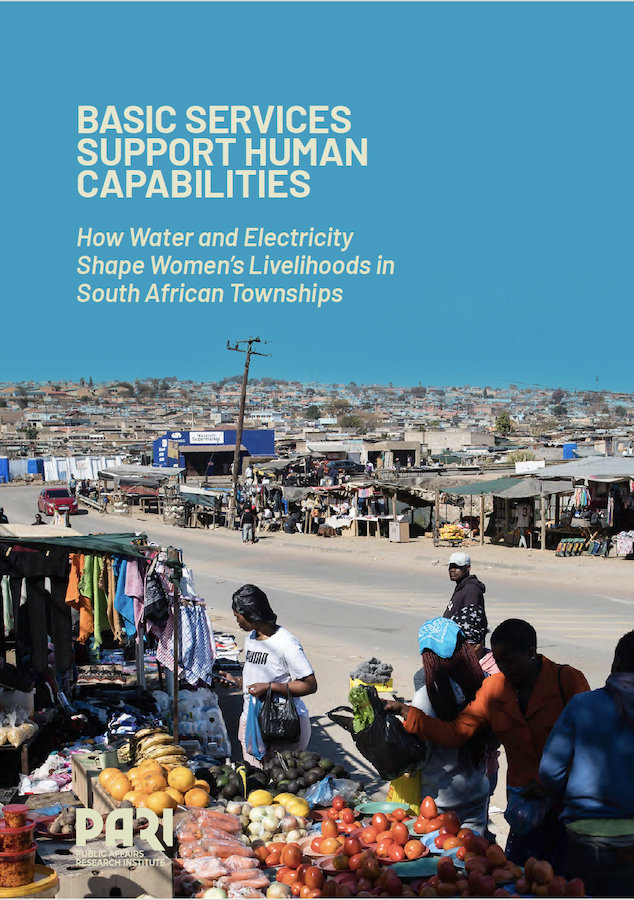
How water and electricity shape women’s livelihoods in South African townships
By Nonhlanhla Mathibela
This research seeks to highlight the importance of gender- and domestic-conscious service delivery that recognises the dual role of women as both caregivers and owners of home-based enterprises (HBEs) operating from their homes. In this context, basic service provision must be reliable and affordable to support households that depend on these essential services for both domestic and livelihood purposes, thereby enabling the expansion of their capabilities.
This report draws on the capability approach to examine the relationship between access to basic services and women’s ability to improve their living conditions. In response, women rely on social networks and collective forms of support to sustain their households and livelihoods. This perspective resonates with the African philosophy of ubuntu, which understands human flourishing as fundamentally shaped by relationships of care, reciprocity and mutual support.
To explore these dynamics, the research asks the following questions:
1. What factors contribute to the realisation of capabilities of women running HBEs in townships?
2. How do women navigate the intersecting demands of income generation and care work under conditions of water and electricity insecurity?